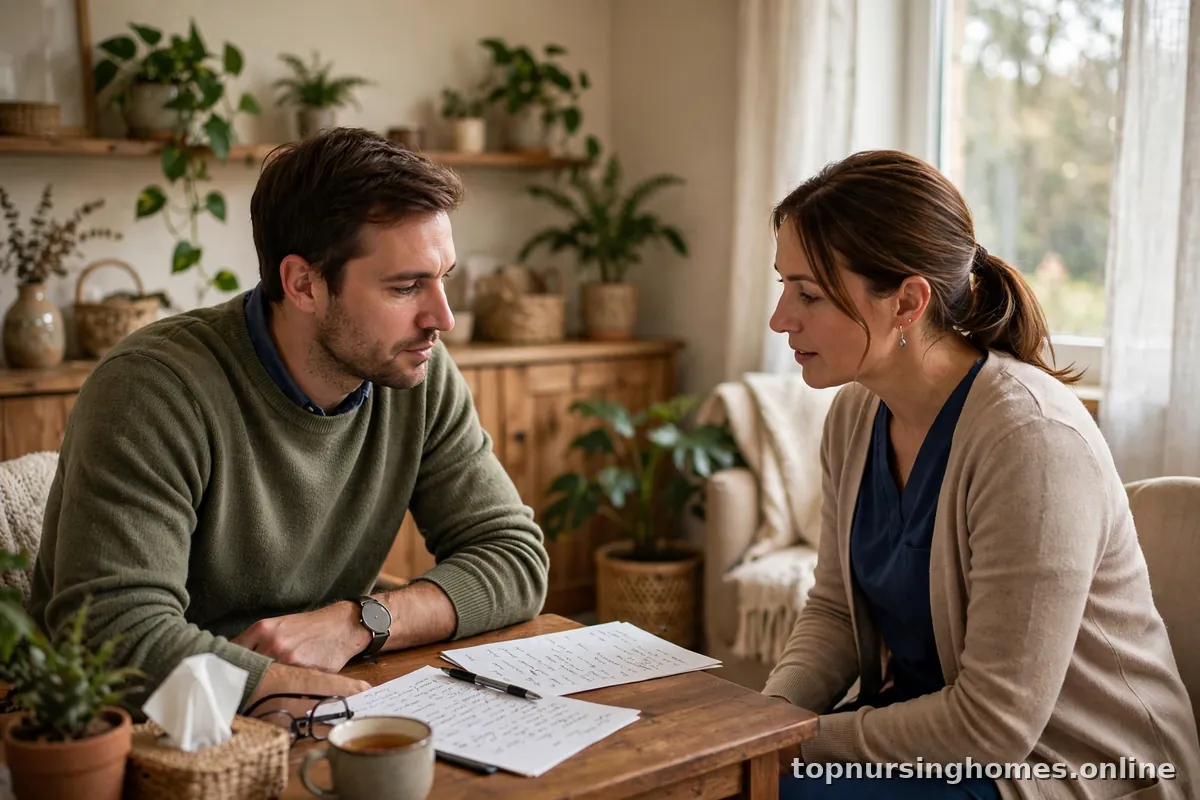
When you sit down with a dementia care provider — whether it is a memory care director, an assisted living administrator, or a home care agency manager — the quality of your questions determines the quality of the answers you get. Generic questions get generic answers. Specific, well-aimed questions reveal how a provider actually operates: how staff are trained, how residents spend their days, how problems get handled, and how families stay in the loop.
This article gives you those questions, organized by topic, with notes on what good and concerning answers sound like. It is written for families evaluating residential dementia care, but most of it applies to home-based care providers too. As always, questions about a specific person’s medical condition belong in a conversation with that person’s physician — these questions are about evaluating the provider, not diagnosing or treating anyone.
How to Use This Question List
Bring a printed copy or keep it on your phone during tours and interviews. You do not need to ask every question in one sitting — prioritize the sections that matter most for your situation, and save the rest for a follow-up call. Write down the answers, and note not just what was said but how it was said: confidence and specifics are good signs; vagueness, defensiveness, or “we’ll get back to you” on basic operational questions are not.
Interview at least two or three providers. Answers only become meaningful in comparison — one provider’s staffing ratio sounds fine until you hear another’s.
Staff Training, Staffing Levels, and Consistency
Start here, because staffing shapes everything else. Ask:
What dementia-specific training do caregivers receive, how many hours does it include, and how often is it refreshed? Listen for specifics — named training programs, hour counts, annual refreshers. “Our staff are all trained” without details is not an answer.
What is the caregiver-to-resident ratio on each shift, including nights and weekends? Ratios often thin out on evenings and weekends; ask about every shift, not just the daytime one you are touring.
How much do you rely on temporary agency staff, and what is your staff turnover rate? High turnover disrupts the consistent, familiar relationships that people with dementia depend on. If the provider will not share turnover figures, treat that as an answer.
How do you handle it when a caregiver calls in sick? The backup plan reveals whether the unit is staffed with real redundancy or running on a knife’s edge.

For background before these conversations, read the nursing home staffing transparency guide so you understand what published staffing figures actually measure — and what they leave out.
Daily Life, Activities, and Engagement
A good dementia care program has a rhythm to the day. Ask:
What does a typical day look like for a resident? Ask to see the current week’s activity calendar, not a sample one. Look for variety — music, movement, art, outdoor time, small-group and one-on-one options — rather than a single television-centered routine.
How are activities adapted for residents at different ability levels? A program that runs one activity for everyone, regardless of ability, is not really personalizing care.
How much time do residents spend outdoors, and is the outdoor space secure and actually used? Secure courtyards and gardens are a hallmark of thoughtful memory care design — but only if residents genuinely get out there.
How do you learn about a new resident’s personal history, preferences, and routines? The best programs build a “life story” for each resident — former occupation, music they love, foods they prefer, what calms them — and use it in daily care. Ask how that information is collected and shared with the care team.
Behavioral Approaches and Communication
People with dementia sometimes express distress through behavior — agitation, restlessness, resistance to care, or vocal outbursts. How a provider responds defines the culture of the place. Ask:
When a resident becomes agitated or distressed, what is your staff’s step-by-step approach? Listen for person-centered language: redirection, identifying unmet needs (pain, hunger, needing the bathroom), environmental adjustments, one-on-one calming. Be wary of answers that jump quickly to medication or isolation.
Under what circumstances are medications used for behavioral symptoms, who prescribes them, and how often are they reviewed? This is a facility-philosophy question, not a medical one — medication decisions themselves belong to the person’s physician. You are checking whether the provider treats medication as a last resort with regular review, or as a first-line convenience.
How do staff communicate with residents who have difficulty speaking or understanding? Look for answers about simple language, visual cues, patience, and validation techniques — not frustration or rushing.

Health Monitoring, Safety, and Emergencies
Ask:
How are changes in a resident’s condition detected and communicated to families? You want a clear chain: who notices, who decides it matters, and how quickly the family hears about it.
What medical support is available on site, and what happens in a medical emergency? Clarify whether a nurse is on the unit around the clock or on call, how hospital transfers work, and which hospital the facility typically uses.
How are falls prevented and handled, and how are families informed after a fall? Falls are a leading concern in dementia care; the provider should have a prevention approach and a transparent notification policy.
What is your approach to nutrition and hydration for residents who have difficulty eating? Weight loss is a common issue; ask how it is monitored and what interventions look like before it becomes a crisis.
It also helps to understand the broader payment landscape before you commit. Review how Medicare covers short-term nursing home care so you know what Medicare does and does not pay for — many families are surprised to learn that long-term residential dementia care is generally not a Medicare-covered benefit.
Family Involvement and Communication
Ask:
How and how often will you update our family? Scheduled care-plan meetings, a named contact person, and a clear policy for urgent versus routine updates are what you are looking for.
What are the visiting policies, and can family join meals or activities? Flexible visiting hours and genuine welcome of family participation are good signs; rigid, narrow visiting windows are not.
Is there a family council or support group, and how does the facility handle complaints? A provider with a real feedback channel — and a clear escalation path — is a provider that expects to be held accountable.
How do you support families, not just residents? Dementia affects the whole family. Programs that offer caregiver education, support groups, or counseling referrals understand the full picture.
Costs, Contracts, and What Happens When Needs Change
Ask:
What exactly does the monthly rate include, what costs extra, and what triggers a rate increase? Get it in writing. Ask specifically about levels-of-care tiers, which can raise costs substantially as needs grow.
If the resident’s needs increase beyond what this setting provides, what happens? Some providers can add services; others will require a move. Knowing the discharge conditions now prevents a crisis later.
What is the move-out notice policy, and are there any non-refundable fees? Read the admission agreement carefully before signing — or have an elder-law attorney review it.
Seasonal concerns deserve their own questions too. Cold weather brings specific risks for people with dementia — from unsafe wandering in winter conditions to heating and hydration issues indoors. Ask providers how they handle winter-specific safety, and read our guide to winter safety for memory care residents for what thorough cold-weather planning looks like.
Evaluating the Answers: Green Flags and Red Flags
Green flags: specific numbers and named programs instead of vague reassurance; staff who speak about residents with warmth and individuality; a willingness to show you the real unit, not just the model room; transparent discussion of inspection history and how deficiencies were corrected; and families who are visibly present and comfortable.
Red flags: defensiveness about staffing or inspection questions; pressure to sign quickly; a beautiful lobby paired with a neglected resident wing; staff who cannot describe the daily routine; no clear answer on who to call with a concern; and promises that sound too absolute — no provider can guarantee outcomes, and honest ones do not try.
After the Interview: Verifying What You Heard
Answers given in an interview are claims — useful, but worth checking. Start with the public record: for nursing-home-based dementia care, look up the facility on Medicare’s Care Compare and read its recent inspection reports, paying attention to whether the issues cited relate to the topics you asked about, such as staffing or care planning. For assisted-living-based memory care, check your state health department’s site for survey results or enforcement actions, since these settings are state-regulated.
Then do an unannounced visit. Return at a different time of day — an evening or a weekend — and observe whether the reality matches the interview: staffing presence, activity levels, the general atmosphere. Talk to a visiting family member if the opportunity arises; a short, honest conversation in the parking lot or lobby can confirm or contradict a great deal of what you were told. Finally, compare your notes across providers side by side on the same dimensions — training, ratios, daily life, communication, cost transparency — rather than going with the provider whose tour was simply the most polished. The most polished tour and the best care are not always the same place.
General information only — not medical or legal advice. Always verify with licensed professionals.
The right questions do more than extract information — they show the provider that this family pays attention, which is itself a form of advocacy for your loved one. Bring this list, take notes, compare providers side by side, and discuss what you learn with the person’s physician and your family. The goal is not a perfect facility — it is an honest one, where your loved one will be safe, known, and treated with dignity. For official quality data on nursing-home-based providers, Medicare’s Care Compare at medicare.gov/care-compare and the Centers for Medicare & Medicaid Services at cms.gov are the authoritative starting points.